
A Human Being Greater Than Life
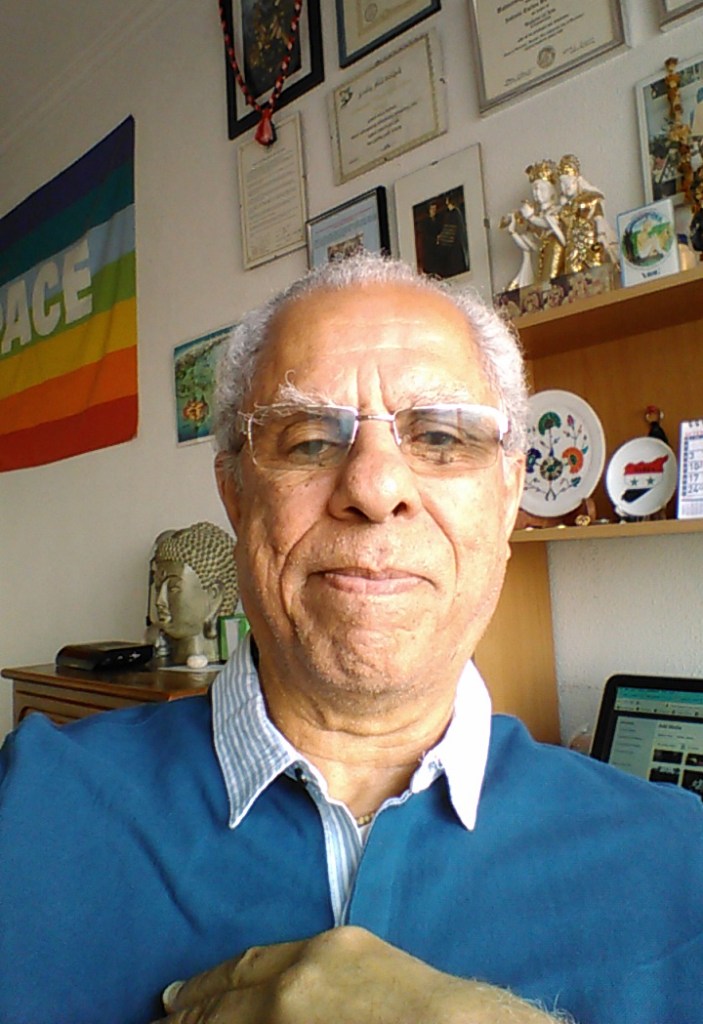
Antonio is the founder-editor of Transcend Media Service, TMS, and an old friend of Johan. More about him here.
I met my friend and mentor Johan Galtung when I was an undergraduate at the University of Hawaii, Honolulu, in 1986. He had a personal way of dealing with his students; at the end of each semester Johan would host a small reception in his house. That was a door for him and I to become closer.
I hardly knew that I was getting a lifelong best friend, well-wisher, employer and, above all, a mentor.
At that time, I was dealing with a life-threatening addiction and Johan proved to be magnanimous, human and kind in reacting to the greatest problem I faced in this lifetime. He was not religious, but was fond of Buddhist doctrines and teachings. This perspective kept him around trying to do what he could to assist and offer me a helping hand.
I know first-hand of his superior character, his humanity and empathy; I bear witness to it and this has been the strongest link in our relationship. I have been in recovery, clean and sober, for 28 years now and can avail clearly, with a deep sense of gratitude, the value of his participation in my life—from 1986 to 2024.
It was with this sort of attitude that Johan approached the fields of peace and conflict studies at all levels, worldwide: personal, familiar, school (bullying), workplace, religious, national, civilisational as presented in his book, “50 Years, 25 Intellectual Landscapes Explored.”
I remember once, at a beach in Alicante, Spain, where he lived at the time, he turned to me and said that all those passersby enjoying the early afternoon sun with their families and pets would reminded him of Louis Armstrong’s hit song, What a Wonderful World, that went like this:
“I see friends shaking hands
saying how do you do
they’re really saying, I love you.”
Such was the mental environment of the man who left the tools for the world to save itself from itself. For human beings to become truly civilized and not merely deceiving themselves with wishful thinking about that.
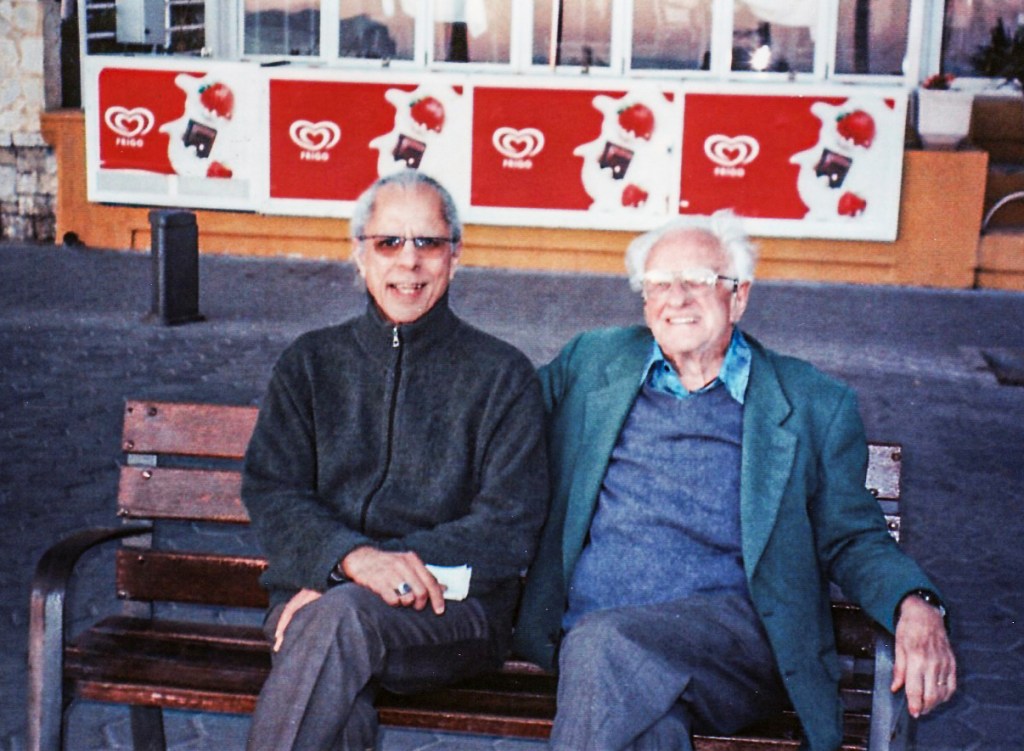
When I left Honolulu for Lisbon in 1994, we lost contact. Then, in 2004, I casually googled Johan Galtung and found his phone and address in France. I called, and his wife Fumiko answered the phone, and we reconnected – for good. Shortly thereafter I was translating one of his books to Portuguese, “Transcend and Transform.” And after that, another one, “Reporting Conflict – An Introduction to Peace Journalism.”
In 2004, I moved to Torino, Italy, to be a full-time assistant to Johan, working from out of a borrowed space at the Centro Studi Sereno Regis. The rest is history, as they say.
I travelled the world under his auspices, and in 2008 Johan envisioned, and we implemented, the pioneering TRANSCEND Media Service – Solutions Oriented Peace Journalism of which I have the privilege to be the editor to this day. It has been almost half a century of an spiritually uplifting journey that forever changed my life and my destiny.
No drama intended in this factual account of my reality with Johan Galtung.
I once asked him two questions – among thousands of others – which I would like to share:
Q. What is your definition of an intellectual?
A. An intellectual is someone who transforms impressions into expressions.
Q. What is your definition of intelligence? (Johan’s IQ ranked him as genius.)
A. Intelligence is the ability of multitask.
He wrote some four or five books simultaneously, as I witnessed in his house in France, with piles of papers carefully organized in a seemingly disorganised fashion.
The couple, Johan and Fumiko, had houses in Spain, France, USA, Norway and Japan, plus a trailer. They took care of all personally, never having a housemaid and taking pride in it. Fumi was a superb cook who ‘invented’ vegetarian dishes especially for (grateful) me.
He wrote an autobiography in Norwegian in 2006, with no translations: “Johan without Land – On the Road to Peace Through the World.”
In the epilogue, “war” is mentioned as a dying phenomenon. The other variants are: “guerrillas” as civilians against military, “state terrorism” as military against civilians (for example the bombing of Dresden or Hiroshima and more recently the Israeli genocide in Gaza), and “terrorism” as civilian attacks on civilians. Also, “state terror” as new terrorist-based strategies, especially after 11 Sep 2001.
Johan was never awarded the Nobel Peace Prize in spite of being nominated practically every year since the 1950s. The reason: he was always very critical of Norwegian policies both domestic and foreign. The Nobel Peace Prize Committee in Oslo has always been composed of persons who disapproved of, or outright disliked, him. He was a celebrity in Norway recognized on the streets but also hated by others.
Unfairly accused of antisemitism, he was forced out of the World Peace Academy in Basel, Switzerland and of the European Peace University in Stadtschlaining, Austria (both of which had been co-founded by him).
Another phrase that made him (in)famous in 2009: “I love the US republic and I hate the US empire.”
Fumi had to insist that he buy new shirts because he was anything but vain and superficial. Simple, humble – also arrogant at times, demanding at other times – Johan was a prototype of the homo sapiens, a label mistakenly applied to humans as a whole. In my view, we are divided in 190 warring tribes, technological savages who would better fit the label homo barbaricus. Johan visited most of these tribes to inspire them through civilising lectures, insights, teachings.
After Mikhail Gorbachev implemented his Perestroika and dissolved the Soviet Empire, sources from inside the Kremlin informed Johan, in Moscow, that his papers and writings were used to help their decision-making showing him annotations and notes in their margins.
Johan was not a founder of religion but his legacy will someday show that his approaches to conflict and peace studies will have the same impact on humanity that religions seek to have. Concentrating on the positives, points of agreement, acknowledging contradictions/differences and bent on searching for solutions with which all parts could live, he focused on cultures and structures as hosts to violence – as the smoke, conflict being the fire that must be put out in order to eliminate the former.
Johan’s MO was loyalty, intellectual integrity, personal honesty. He lived practically for the world. To conclude, another intimate moment we shared:
One day, we were working together in his house in France and during a break, we went to pick up berries in the garden. As we did it, he disclosed that at the University of Hawaii he had felt helpless in trying to help me with the addiction problem, but waited, filled with compassion, for an opportunity to act. He quoted Buddhism as a major source of inspiration for him. Finally, that opportunity manifested itself. I was OK, and he was OK.
I had the privilege of coming across a Spiritual Master from India and a Material Master from Norway. They changed the quality of my earthly life for the better by pointing out to me positive new directions. As a human being, I still endeavor to live up to their high standards of excellence.
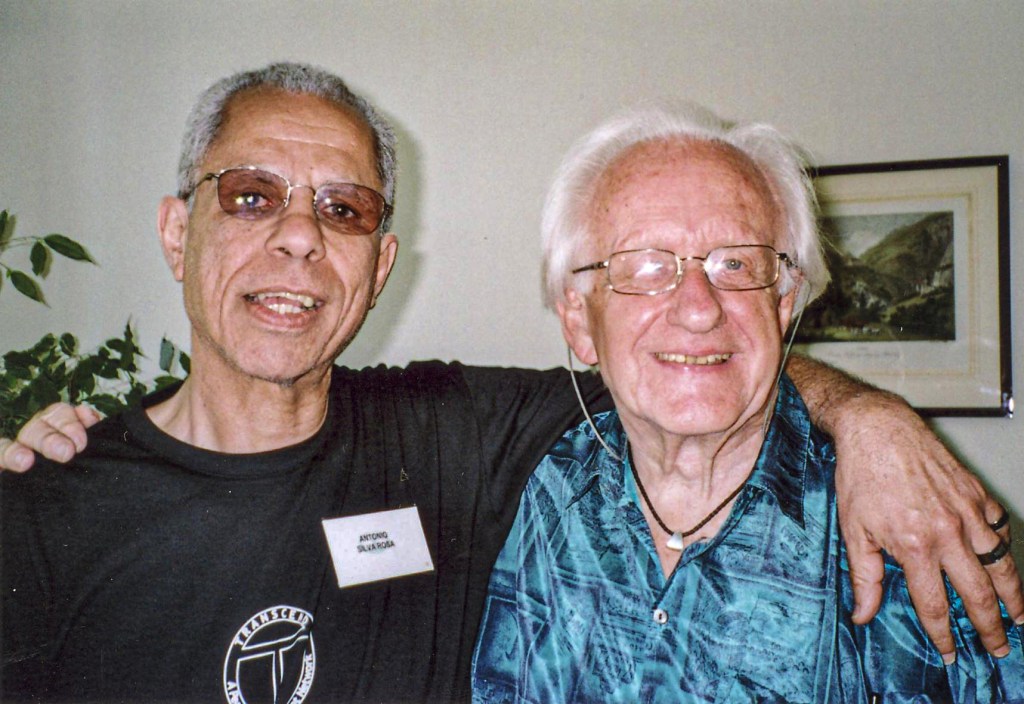
Conversation: Antonio Rosa and Johan Galtung – In Memoriam
By Marilyn Langlois
•
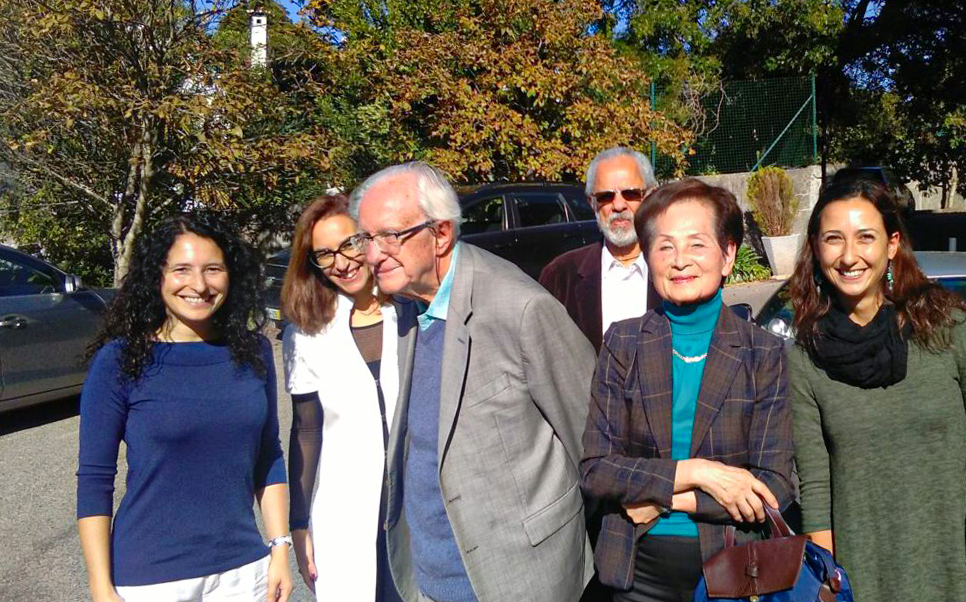
Antonio C. S. Rosa
Born 1946, is founder-editor of the pioneering Peace Journalism website, TRANSCEND Media Service-TMS (from 2008) under Galtung’s inspiration and guidance. He was Johan’s assistant, Secretary of the International Board of the TRANSCEND Network for Peace Development Environment, and recipient of the Psychologists for Social Responsibility’s 2017 Anthony J. Marsella Prize for the Psychology of Peace and Social Justice.
Antonio completed the required coursework for a Ph.D. in Political Science-Peace Studies (1994), has a Masters in Political Science-International Relations (1990), and a B.A. in Communication (1988) from the University of Hawai’i. Antonio is originally from Brazil, he lives presently in Porto, Portugal. Antonio was educated in the USA where he lived for 20 years; in Europe-India since 1994.
Books
“Peace Journalism: 80 Galtung Editorials on War and Peace.” (editor) – Cobertura de Conflitos: Jornalismo para a Paz (by Johan Galtung, translation to Portuguese) –
“Transcender e Transformar: Uma Introdução ao Trabalho de Conflitos” (by Johan Galtung, translation to Portuguese). TMS articles by Rosa here.
•
 Johan Galtung 1930-2024
Leave a comment