
Memories of Johan over 50 years
Erni & Ola Friholt are two teachers who left teaching in the 1960s to work full-time on solidarity, peace and justice. They worked in India with local organisations on organic agriculture in low-caste villages, self-reliance in a Chennai slum, and in villages with indigenous people in Jharkhand. At home, they work on advocacy on peace and justice within the Peace Movement on Orust, a small island north-west of Gothenburg. For years, they were also book publishers and managed a peace café.
Jan Oberg produced two videos in 2021 with Erni and Ola which you may enjoy here and here.
And here is Erni with Johan…
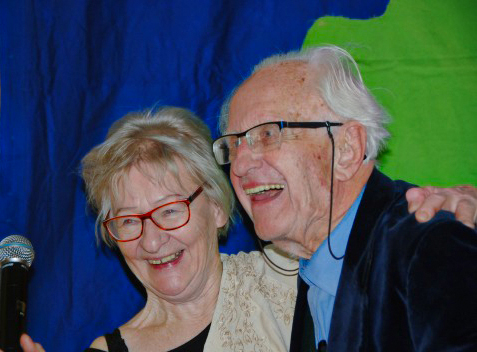
One morning in the nineties
On a warm sunny day with calm waters next to our house there was the sound of a car breaking on the land side. Out stepped Johan Galtung. He came from Oslo on his way to a lecture in southern Sweden and thought he would take his coffee break with us. It meant a detour of a hundred kilometres instead of the nearest coffee shop…We felt very honoured.
We sat on the bench on the seaside, and the pause became quite long. We kept talking about peace work matters and about world politics.
Unlike his usual efficient hurry, Johan asked about our local peace work and dropped some comments in between. Among other things, we learnt about the uninterrupted killings by the CIA from its inception until that day; they amounted to about six million people in different countries.
Even including such things, it was a very warm and personal sit together, which remains in living memory.
Close partners in the periphery
Our first contacts came much earlier when we invited Johan for lectures that we arranged with the People´s University in the seventies. In the eighties, we were so well acquainted that we invited a group of university people and activists in various fields, like environment, peace, solidarity, social research, etc. for dialogues around a book project led by Johan and Mats Friberg.
We sat on our boat landing space with some interruptions for food, drinks, songs and conversation.
We contributed to the three volumes with two articles on peace problems and visions for the future. Johan commented on every essay that the group members presented. He did it in an encouraging, constructive way, never pointing out specific weaknesses.
The three books that resulted were generally mentioned as The Crisis Trilogy. When the press interviewed Johan, he mentioned Stocken – at the island of Orust where we still live – as the centre of this project. However, the press called it Stockholm…
Of course, they had no idea about Stocken or our Peace Movement of Orust, which is just yet another example of how peace workers are generally made invisible. Anyway, we felt very much stronger and hopeful, thanks to Johan’s confidence.
Seminars in an old countryside school
In the early years of 2000 our contacts with Johan became closer. We invited him for a series of seminars over weekends. The venue was the very old school where Ola spent his first four school years in the forties. Among other subjects, like conflict resolution, there was one about the importance and process of reconciliation.
In the light of today´s hate and denigration of counterparts in ongoing conflicts, this seminar seems especially important in hindsight. Johan explained at length the Hawaiian method called “ho-o-pono-pono” – “to make everything better”.
During one of these seminars, Erni was abroad for a women’s international conference, and Ola hosted Johan and his wife Fumi. At dinnertime on Saturday evening, Ola prepared the delicious turbot fish.
It was very much appreciated, especially by Fumi, who said: “This is the best dinner I have for a long time!” Johan immediately commented: “Don’t compare!”
We did understand his idea that nothing shall be considered less good, useful, or laudable. But principles may sometimes become excessive, rigid…
In our guest book they both wrote lovely things. Fumi ended with: “I learnt a lot.”
Some memorable moments
Johan participated in Brazil in one of many big meetings for alternative development. From there, he sent us a postcard with the text: “Here I meet hundreds of Ernis and Olas.” No, we are indeed not the only ones to be neglected by the overlords of the earth… In a way, he used us as the standard measurement of the qualities of all participants. Should we not be honoured?
In 1987, we participated in the celebration of “The Right Livelihood Award.” Along with persons representing the struggle against deforestation in Himalaya, Johan received the Honorary award.
When waiting for his reward during the speech of the Himalayan representative, he was – not surprisingly – busy reading and correcting some manuscript. He seemed to never rest, except once…
Together with his old school mate, Frede, he visited Stocken to give a lecture. They arrivedd in Johan´s camper. After dinner, we invited all our guests to a tour in our boat through the peaceful archipelago in the beautiful sunset hours.
But, about to leave, we found Johan asleep in his camper. We left without him, and when we returned, Frede was a bit too anxious to get quickly back up on land and, so, fell overboard. In soaked clothes, he became very heavy, and not until two night wanderers happened to walk by could we get him up on land.
After a shower and some dry warm clothes, he asked us: “Please don’t tell Johan about this.” The following day at breakfast, we all knew that there was at least one thing that Johan did not know.
Books
His many books were, in fact, a university for peace activists. He provided us with a terminology for our efforts to reveal broader perspectives and truths about international political developments. We learnt about “structural violence”, “deep culture”, i.e., “social cosmology”, “the conflict triangle“, ”positive and negative peace”, and many more valuable tools.
That was, it must be said, for as long as it lasted. Today, our efforts to reveal the many lies and constructed narratives about, say, the war in Ukraine have been met with a total media blockade. It has become virtually impossible for us to practise the right to free speech and present facts or opinions in the local papers; the Orust Peace Movement has also been barred from localities such as the local cultural centre and church-related meeting rooms that we have used for about 10 lectures and seminars a year for 35 years!
Developments in international politics take their toll on local communities far away on a small island.
In his book “60 Speeches of War and Peace,” we found a speech he held at Columbia University, in which he states four necessary preconditions for solving the Israeli/Palestinian conflict. They are that “both parties have an inalienable right to live in the area and also that any solution has to be symmetric. What you demand of the other side you also demand of yourself – and what you do not demand of yourself, you do not demand of the other side”.
These ideas were indeed not acceptable for the overwhelmingly powerful non- democratic but ethnocratic dominant state built on unequal rights and in fact apartheid.
Therefore – and sadly so – Johan was smeared as antisemitic, which reached as far as the Orust community assembly, where representatives of the liberal party associated the Peace Movement of Orust with a lecturer of antisemitic inclination. We invited them to read about a meter of Johan’s books in our bookshelf, but – predictably – no one was interested.
Again, international politics runs deep into local rural societies…
Johan participated in the celebration when the two of us turned 120 years – together. On that occasion he gave us his book “Peace by Peaceful Means. Peace and Conflict, Development and Civilization” with the following dedication: “Till Ola och Erni – 120 år! I beundring, venskap, og kjaerlighet! Stocken, 26/04/97 Johan.” (To Ola and Erni 120 years. With admiration, friendship and love!)
After his signature, he added the Swedish word ”rackare” which means rascal. Thus, he reminded Erni of her complaint on another occasion when he arrived very late without informing us on the way.
He found that title amusing because of the contrast between the professor and doctor honoris causa mult and the old title of a man who takes care of dead horses – a rascal. We are still moved by his dedication.
On the occasion of The Peace Movement of Orust celebrating 30 years of existence and activity, Johan gave us his newest book “A Theory of Peace. Building Direct Structural Cultural Peace” with the following dedication in Norwegian: “First copy of an edition of 1000 on Day One, 24-05-13. Congratulations Ola & Erni to the 30 years’ jubilee – Johan”
The last years
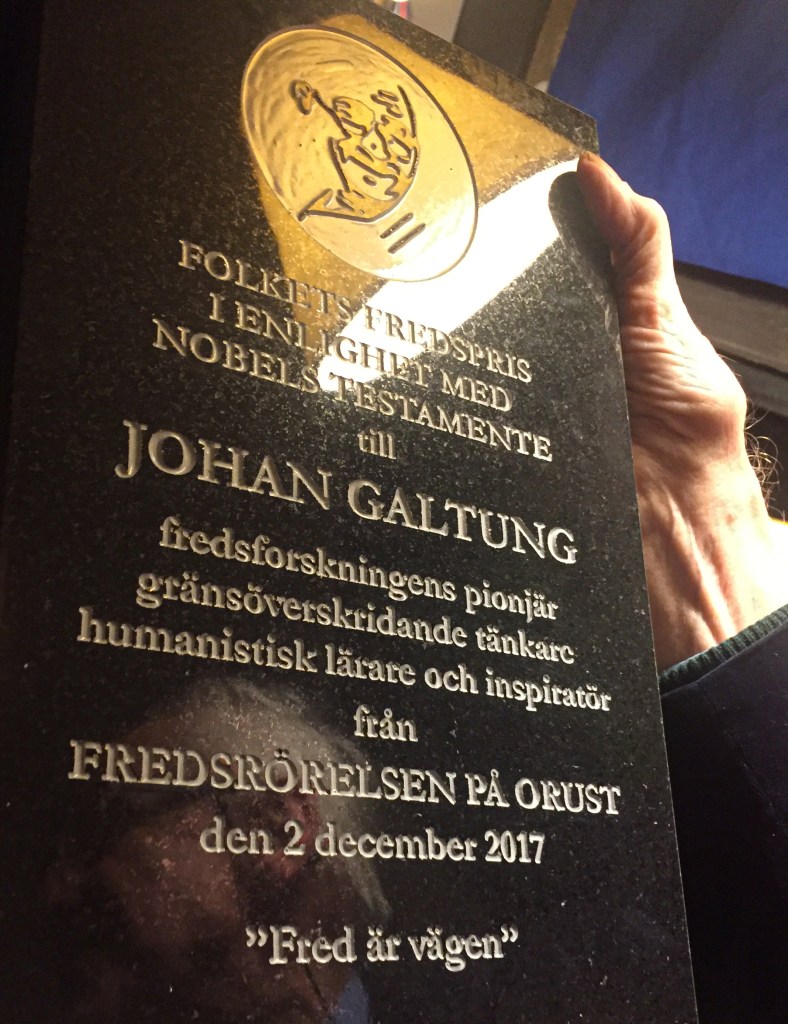
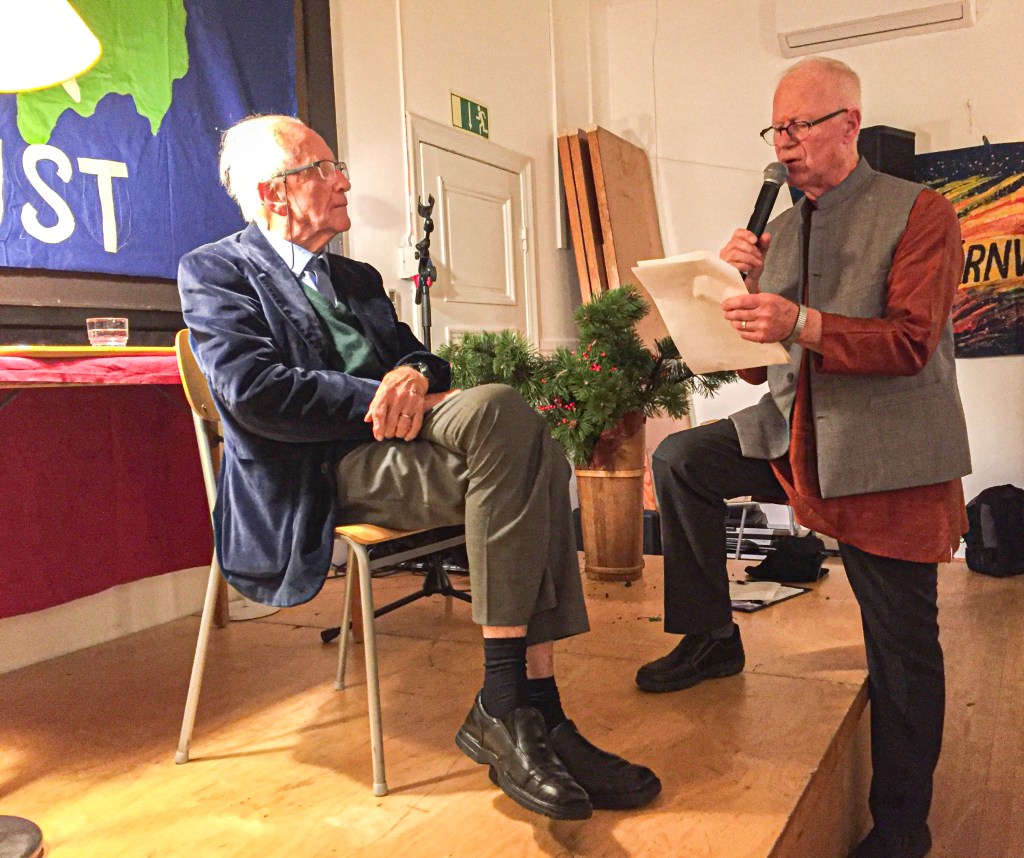
In December 2017, the Peace Movement of Orust honoured Johan with its prize “The People´s Prize for Peace in Accordance with the Testament of Nobel”.
In Ola´s usual versified speech to Johan he ended by saying approximately this (in Swedish):
“The prize that Oslo never gave to you
instead, wholeheartedly was given to
environmental work or military violence
accompanied with everybody´s shameful silence.
But now Alfred Nobel will feel content,
for the conditions of his testament
are totally fulfilled by you, Johan,
and worthy of the prize, the people´s man!”
As usual, Johan gave a very thoughtful lecture on peace matters that concern us all, brain and heart. We handed over the engraved stone to him, though its weight was too much for his flight luggage – or his remaining body power. It was sent later.
During the festival dinner, we noted that he had little appetite. We felt something decisive was underway, although he had a Skype conference in the middle of everything!
Later on, he stopped replying to our birthday greetings and emails. He had always replied immediately. Then we received a short video from his daughter Irene where Johan speaks about mental attitudes and ways to peace – actually, a short summary of his life work.
It was a portrait of an emaciated old man still mentally perfectly sharp. And that was our last view of Johan.
We lack words about the tragic and undeserved last months of his life.
We miss him dearly.
Erni & Ola Friholt
 Johan Galtung 1930-2024
Leave a comment