
The Lessons Learned From Johan: Peace requires mind and heart equally
Unlike many scholars who developed an interest in peace studies when the field was either emerging or flourishing after the Cold War, I did not have the luxury of approaching it through mere academic curiosity. My journey was shaped by the harsh realities of a disintegrating homeland. As I worked on my doctoral dissertation, envisioning a stable academic future, Yugoslavia—a country I once thought was among the most beautiful and peaceful in the world—descended into chaos.

The author
By then, I was already an assistant professor at the Institute of Defence within the Faculty of Philosophy in Skopje, Macedonia. Each day was filled with disbelief and horror as war engulfed the region. This was not just any conflict but one of the bloodiest wars in Europe since World War II.
Academic pursuits became secondary as more pressing questions emerged: How could this happen? How could neighbours and even family members turn on each other? How did hatred spread so quickly, culminating in ethnic cleansing and the redrawing of borders?
Though Macedonia was spared the immediate horrors and was even called an “oasis of peace,” the pain was palpable. The collapse of the iconic Mostar Bridge, the shelling of beloved Dubrovnik, the siege of Vukovar and Sarajevo tore at our collective heart. I sensed that Macedonia’s peace oasis was fragile—a delicate illusion that could shatter at any moment. In those uncertain times, I had a profound need to understand my society and the region’s collapse. I refused to accept simplistic narratives portraying us as inherently militant or cursed.
In such dire circumstances, fortunately, an older professor from the Faculty of Philosophy (a psychologist by vocation) got the opportunity to travel with other colleagues from former Yugoslavia and meet scholars working on peace and conflict issues. On her initiative, the Balkan Center for Peace (BCP) was established, and soon a one-year specialist studies program. I helped her create the curriculum, although we were aware that we were students, not professors – that a long path of learning lay ahead of us.
Due to certain circumstances that are difficult for me to write about, I remained outside the teaching staff, but my curiosity and desire to learn remained. The small library at BCP was filled with books donated by our foreign colleagues (Theodor Herman, Johan Galtung, and many others).
Johan Galtung, whom we called the father of peace studies, I first met through his written works, and a few years later in person. In the period before meeting Johan, my guru and teacher in this field was his close friend and collaborator, then-director of the Copenhagen Peace Research Institute (COPRI), Swedish-born Håkan Wiberg.
Shortly after the end of the NATO bombings in 1999, an opportunity arose to meet Johan – as a participant in a summer school where he taught his TRANSCEND method of conflict transformation. My older colleague, the founder of BCP, for reasons unknown to me, did not share the news about the two-week school at the Central European University in Budapest (CEU) and the opportunity to apply. But thanks to a Bulgarian colleague, I applied and found myself in the lecture hall where Johan shone.
Håkan decided to join on his own initiative, so I found myself between two top peace researchers, who accepted me as someone worthy of being heard and guided.
Incidentally, Yugoslavia was the country that connected all of us. They jokingly told me: “We are bigger Yugonostalgics than you, because we loved Yugoslavia even before you were born!” (Johan had been the director at the Inter-University Center, IUC, in Dubrovnik in the mid-1970s).
In my mind, Johan was already a giant whom I admired because from him I understood both the theory of violence and the theory of peace and ways of transforming conflicts (instead of “resolving” them). What meant most to me was Johan’s belief that you cannot be a peace researcher with just a cool, rational mind, you also need a heart – empathy, solidarity, and a wish to understand what drives people into violent conflict rather than judge them.
Another important aspect was his insistence on creativity and vision for achieving positive peace – both at the local and global levels.
When I met him in person, Johan was a 69-year-old man (a few years older than my current age). Due to his white hair, some might have given him more years. But he was a man of incredible charisma, with vitality radiating from him, both in the way he spoke and moved. He communicated with all of us as equals, as if we were the closest – even though there were those like me who were meeting him for the first time. He was not only an incredible lecturer, who made you regret when the day-long lecture ended, he was also open to listening. To thinking about our comments and questions!
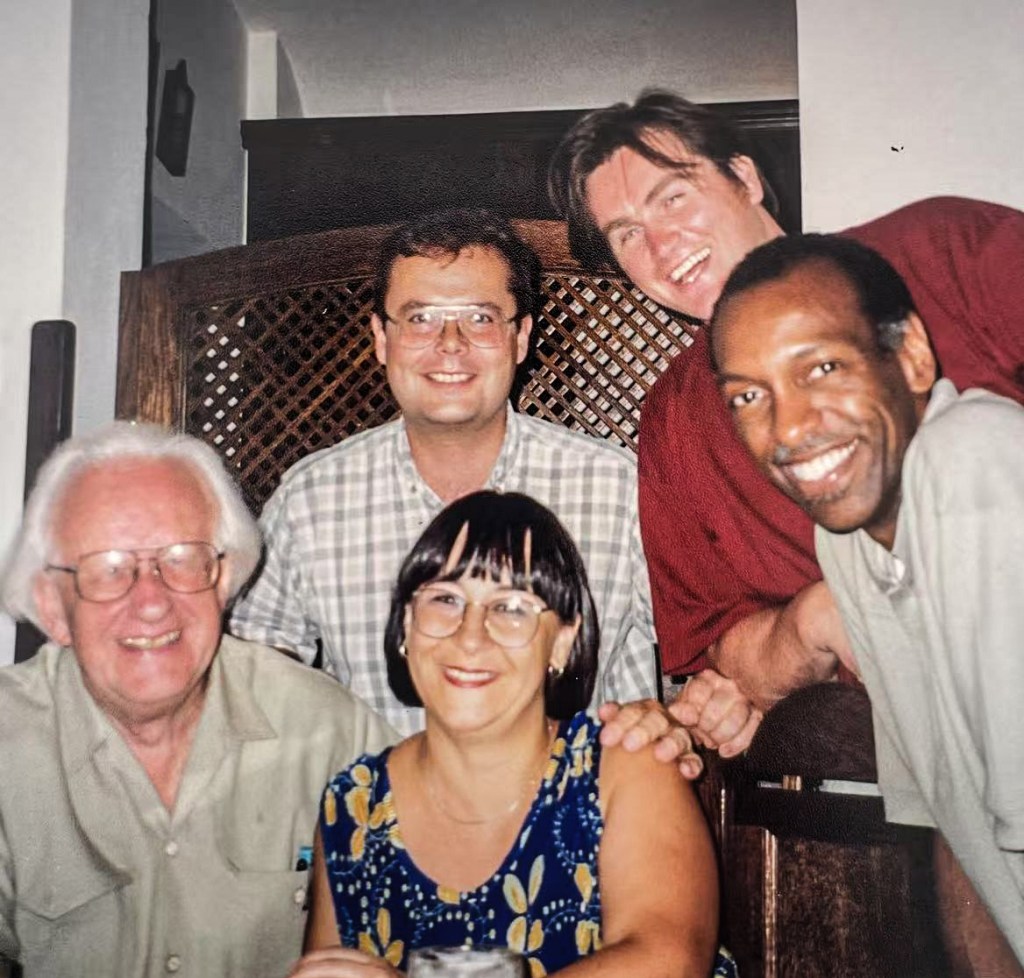
At the 1999 summer school with other students
One of the most interesting episodes from our first meeting (which was followed by several others over the years) ended with Johan approaching me during a break and saying, “Biljana, from this moment you can write in your CV that you left Johan Galtung speechless!”
I smiled in disbelief at such a compliment, but he was serious. Namely, a few moments earlier, while he was evoking memories of how, many years ago, he had informally mediated between statesmen from conflicting states, and after the opportunity for a meaningful conversation about resolving the dispute had failed, he suggested they sit down for an informal drink at the bar.
The point was that in such situations, somewhat rigid people may step out of their official roles and shoes and talk as human to human – and thus understand each other more easily.
I spontaneously wanted to make a joke, so I asked: “If I, as a woman, were to do that, what do you think, how would I be perceived? Would it be appropriate? Or might I be misunderstood?” I don’t know if others noticed, but Johan paused for a second and thought, and then posed my question to the audience.
Even I wasn’t aware that, back then, I was raising a “gender” question and that, indeed, in the world of high politics or peacemaking, there are few women in such positions. But Johan immediately understood the depth of that dilemma, and that’s why he acknowledged that even he had not posed this dilemma before.
Years have passed since then – during which I am still far from sure I have understood everything necessary for my society, region, and the world – especially now that we are on the brink of Armageddon. We met occasionally, communicated, and exchanged opinions mostly via email – but my primary guru and shoulder to cry on remained Håkan.
Johan, despite all his immediacy and warmth, remained a giant to whom I did not want to bother unnecessarily. But he was always there, at least briefly, to respond in situations where I needed confirmation that I was on the right path and thinking correctly about the dramatic events around me (the military conflict in Macedonia broke out just two years after our first meeting, in 2001).
At one plenary lecture in Budapest, Johan spoke inspirationally and held the audience’s breath in the packed hall with the power of his words and the energy that naturally radiated from him. I will never forget his opening words: “This world has a big problem. That problem has a name, and its name is the United States of America.”
From today’s perspective, his diagnosis could not have been more accurate.
The prognosis – and it was not only his but also Wiberg’s – was that the Empire would inevitably collapse in a few decades. But none of us have the real therapy for the consequences of this rampant empire, which negates and lacks everything that positive peace means.
Personally, I first lost Håkan in 2010 – here his memorial site also by Jan Oberg – and in 2024 Johan. We have lost many other great people, either because they get older and lose the strength to write and speak up or because they leave us physically.
The length of Johan’s bibliography and all his other activities are hard to comprehend. There is hardly a topic in the humanities and social sciences to which he did not leave a significant intellectual contribution. And we need those people now more than ever.
I wish we could continue their mission, but the question is: How? The father(s) of peace studies left us at a time when the academic-scholarly and educational field of peace and conflict research has been placed on its deathbed in many parts of the world. Peace institutes have been closed down deliberately, are fading or transforming into security/strategic research centres with no focus on the reduction of all types of violence. Much science is being militarised, along with academia and its financing.
Just now, as I write these words in memory of Johan on the first anniversary of his passing, news reaches me that my Faculty of Philosophy here in Skopje is closing peace studies, obviously considering it unnecessary. A couple of months ago, the Global Changes Centre that I had spearheaded was closed down, and I was dismissed as its director.
In a few months, I will retire and then lose the opportunity to disseminate Johan’s and other peace researchers’ concepts and theories and those of all his followers to new generations of students. What does remain, however, is our ongoing free public engagement, even if we may be considered eccentric, unrealistic or idealistic.
But we have no choice. We are aligned with the fate of the mythical Cassandra – the prophetess cursed by the god Apollo to always predict accurately, but no one would believe her until it was too late. Johan will remain a beacon in the night, a compass in a lost, Orwellian Western world, and a reminder not to confuse negative peace (truce and absence of direct fighting) with a true, human, and socially emancipatory project of true positive peace.
•
 Johan Galtung 1930-2024
Leave a comment